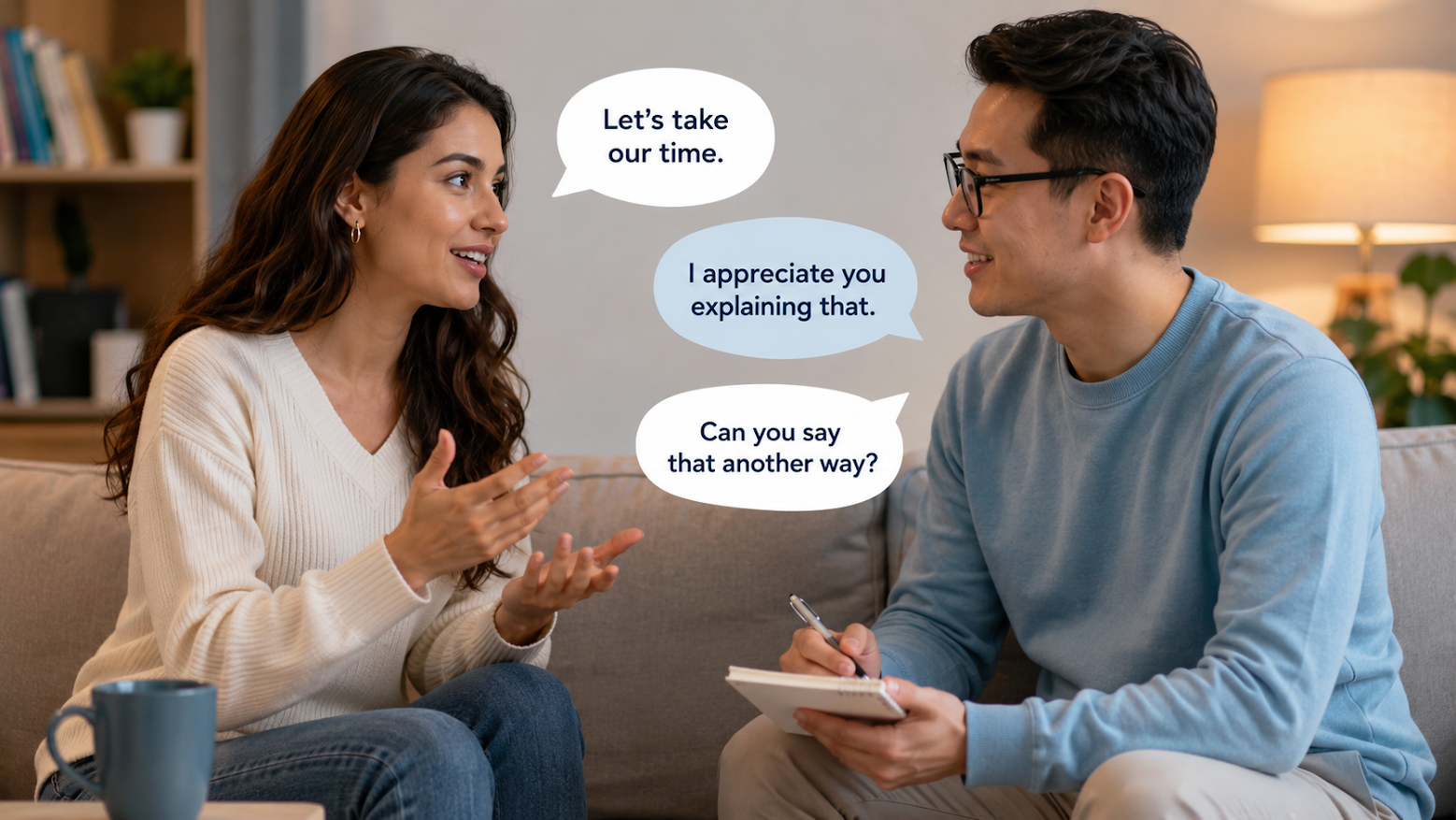
My friend Dasha once told her American husband she was “boiling” — she meant angry, he brought her a fan. They laugh about it now. Back then it started a fight that lasted two days, and neither of them could explain why.
Couples where one person speaks English as a second language are everywhere now. Remote work moved people across borders, apps shrank the planet, and international matchmaking went from a niche thing to a whole industry — sites connecting Western men with Ukrainian mail order brides report steady growth year after year, and those relationships turn into real marriages with real breakfast-table conversations. Which means millions of people are, right now, trying to say “I love you but you loaded the dishwasher wrong” to someone processing every word through a translation layer.
The good news: this is a skill. A learnable one. Here’s what actually works.
Why Miscommunication Happens (and Why It’s Not About Intelligence)
Speaking a second language is expensive. Cognitively, I mean. Your partner isn’t just talking — they’re retrieving vocabulary, checking grammar, monitoring their accent, and predicting your reaction, all at once, in real time. Researchers call this cognitive load. Regular people call it “being completely fried by 8 p.m.”
So when your partner goes quiet during dinner, or answers “yes” to a question that wasn’t yes-or-no, it’s rarely about attention or intellect. Their brain is running a marathon while yours takes a stroll.
There’s also a gap most native speakers never notice: understanding and producing are different skills. Your partner might follow a fast-paced movie just fine yet freeze when asked to describe their feelings about your mother’s visit. Comprehension almost always runs ahead of speech. Sometimes years ahead.
Stop measuring their English by how they talk on a tired Tuesday. Measure it by their best day. That’s who you actually married.
Slow Down — but Don’t Dumb Down
There’s a trap here and almost every native speaker falls into it at least once. You slow your speech… and slide straight into talking like they’re five. Louder. Exaggerated. “DO. YOU. WANT. COFFEE?”
Don’t. Nobody has ever felt loved while being yelled at slowly.
What helps instead:
- One idea per sentence. Instead of “I was thinking maybe we could skip the party since you seemed tired, unless you actually want to go, in which case fine” — break it up. “You seemed tired today. Want to skip the party? Or would you rather go?”
- Pause between thoughts, not between words. The gap gives their brain time to process a complete unit. Slowing individual words just sounds weird.
- Keep your normal volume. They’re not deaf. Honestly this one should be obvious, and somehow it never is.
- Rephrase, don’t repeat. If something didn’t land, repeating the exact sentence louder gives them nothing new to work with. Say it differently — new words are new chances.
The goal is clarity with dignity intact. Your partner is an adult who happens to be operating in their third or fourth language. Treat them like it.
Idioms, Sarcasm, and Cultural Shorthand: The Silent Killers
English is booby-trapped. “Break a leg.” “Piece of cake.” “It’s not rocket science.” Native speakers deploy these without thinking, and each one is a tiny landmine for someone who learned English from textbooks where cakes are food and legs stay unbroken.
Sarcasm is worse. It depends on tone, and tone perception in a second language develops late — often years after fluency. You say “oh great, ANOTHER meeting” and your partner hears genuine enthusiasm about your calendar. Then wonders why you’re grumpy at a job you apparently love.
Same story with cultural references. Jokes about 90s sitcoms, quotes from movies they never saw, sports metaphors from games they’ve never watched. You’re speaking English, technically. You’re also speaking Encrypted American.
Now — the fix is NOT asking “do you understand?” every three minutes. That question is quietly humiliating, and most people will answer yes regardless, just to end the interrogation. Try these instead:
- Follow the idiom with a plain version: “Break a leg — good luck, I mean.”
- Watch their face, not their words. A half-second delay before the nod tells you everything.
- Make it a game. Dasha and her husband keep an “idiom of the week” running joke. He explains one, she teaches him a Ukrainian one in return, they both butcher each other’s expressions horribly. It works.
Arguing Across a Language Barrier
Here’s where things get genuinely hard. Fights.
When you argue in your native language, you have your full arsenal — precision, speed, the perfect cutting remark. Your partner is fighting with one hand tied behind their back. Under stress, second-language ability drops off a cliff. Vocabulary vanishes. Grammar collapses. Some people go mute entirely, and the native speaker reads that silence as stonewalling when it’s actually overload.
Unfair fight. And unfair fights breed resentment on both sides.
Some rules that save marriages:
Take real time-outs. Twenty minutes minimum. Their language brain needs recovery time yours doesn’t.
Move big conflicts to text. Sounds cold, works beautifully. Writing lets your partner think, check a word, edit. Many bilingual couples resolve their worst disagreements over long messages sent from separate rooms of the same apartment. Weird? Maybe. Better than shouting past each other? Absolutely.
Ban the phrase “you always misunderstand me.” It weaponizes the language gap. Once you use their English against them in a fight, you’ve told them their hardest ongoing effort is a character flaw. Very hard to walk that back.
Never mock their mistakes mid-argument. Not the grammar slip, not the mispronounced word. Not even a smirk. This should go without saying and I’m saying it anyway because people do it.
One more thing… winning an argument against someone arguing in their second language isn’t winning. It’s just faster typing.
Let Them Switch Languages Sometimes
Emotional vocabulary lives in the mother tongue. There are feelings your partner can only express accurately in Ukrainian, or Spanish, or Mandarin — words with no clean English equivalent, childhood words, grief words.
So give them room to use it. A few ideas:
- Let them vent in their own language sometimes, even if you catch maybe 10%. Being heard matters more than being decoded.
- Voice messages in their native language, translated later, calmly, together. Great for heavy topics.
- Learn 20–30 words of their language. Just the emotional ones: tired, hurt, happy, scared, miss you. The effort itself says more than the vocabulary does.
When someone can only love you in a foreign language, part of them stays locked away. Handing them the key occasionally — that’s intimacy.
Humor: Building Your Own Two-Person Dialect
Something odd happens to bilingual couples after a year or two. They stop speaking English, exactly. They start speaking Their English — a private mash-up of both languages, invented words, fossilized mistakes that were too charming to correct.
Dasha’s household permanently says “boiling” for angry now. On purpose. It’s theirs.
Linguists have a term for this couple-specific vocabulary, but forget the term — what matters is that this dialect is a health marker. Pairs who build private language are building shared identity. The “wrong” English becomes an inside joke, the inside joke becomes glue.
So don’t correct everything. Correct what they ask you to fix, keep what’s funny, and steal words from their language shamelessly. If your household ends up communicating in a pidgin nobody else can follow, congratulations. You’ve built something.
Tools That Actually Help (and Ones That Backfire)
Technology, used right, is a quiet third partner in these relationships. Used wrong it starts fires.
What helps:
- Subtitles during movie nights — in English, not their language. Reading while listening builds comprehension fast and costs nothing. Painless learning, disguised as a date.
- Translation apps for logistics. Insurance documents, lease agreements, medical forms. Perfect use case. Zero emotional stakes.
- A shared notes file of new words. Some couples keep a running list on the fridge or in a phone note. His new English words on the left, her language on the right.
- Language-exchange evenings. Fifteen minutes of your language, fifteen of theirs. Structured, low pressure, and weirdly fun after a glass of wine.
What backfires:
- Google Translate during arguments. Machine translation strips tone and mangles idioms, so an already tense message arrives sounding either robotic or hostile. A fight plus a translation error equals a bigger fight. Every time.
- Correcting grammar in emotional moments. Your partner says “I am very sadness today” and you fix the sentence instead of asking why. Congratulations, you’ve prioritized syntax over your spouse.
- Speaking for them in public. Ordering their food, answering questions aimed at them, finishing their sentences at parties. Feels helpful. Reads as erasure. Ask privately whether they want backup — some days yes, some days absolutely not.
When to Bring in a Third Party
Some gaps deserve outside help, and reaching for it isn’t failure.
Taking a language class together changes the dynamic completely — suddenly you’re both students, both making mistakes, both laughing at homework. If your partner is learning English, you learning their language in parallel rebalances the whole relationship. Even badly. Especially badly, maybe, because now they get to be the patient one.
For deeper conflicts, look for a couples counselor who works bilingually or has experience with intercultural pairs. A therapist who understands that “he goes silent” might mean cognitive overload rather than contempt will save you months of circling the same fight. Many now work online, so finding one who speaks your partner’s language is easier than it’s ever been.
And if the budget is tight — even a monthly session where your partner can process things in their mother tongue, then share the takeaways with you, moves mountains. Some things need to be felt in one language before they can be explained in another.